
AI-Native Inventory Management Software: Purchase-to-Dispatch, FEFO & Permission-Scoped AI
Short answer
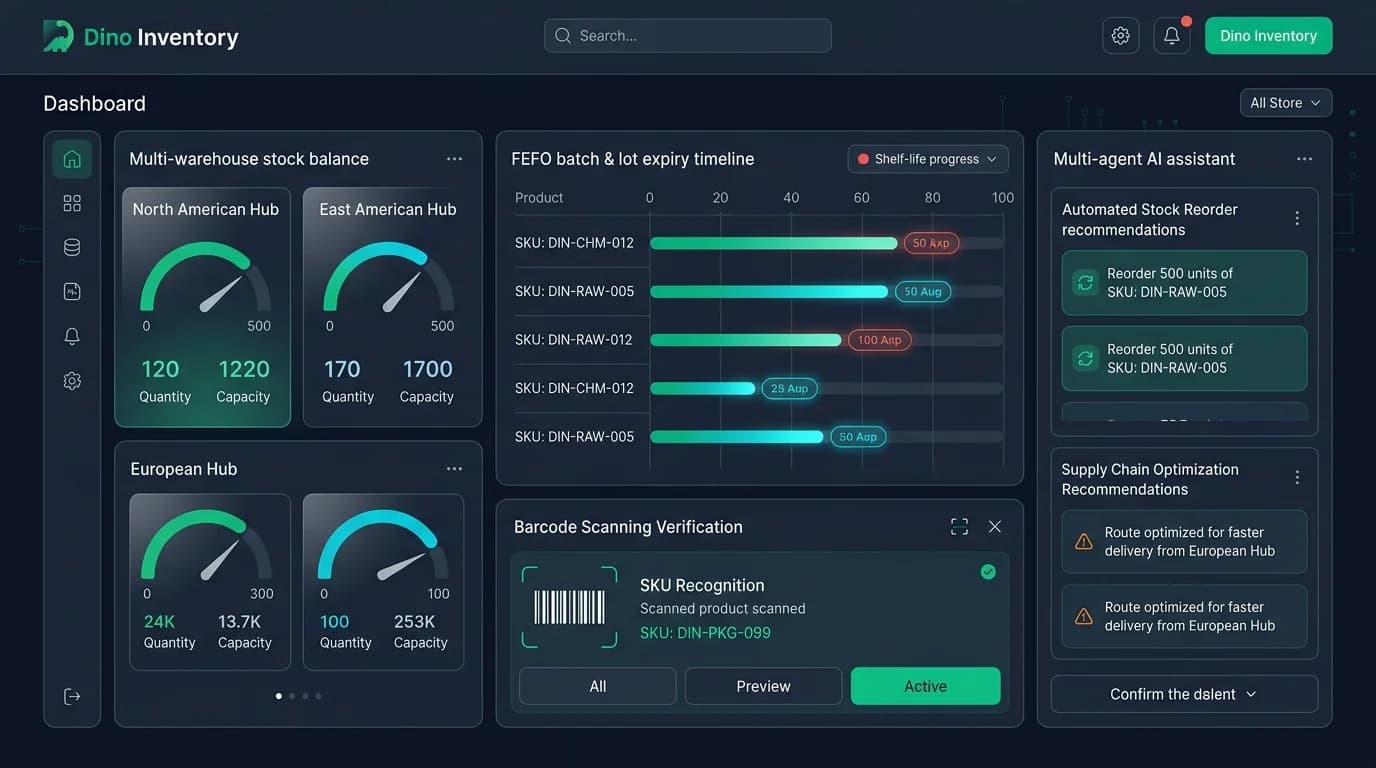
Dino Inventory is AI-native, self-hosted inventory management software from TechDino built for multi-branch stock control from purchase request to customer shipment. It connects RFQs, goods receipts, quality inspection, partial reservations, backorders, inter-warehouse transfers, frozen-snapshot stock counts, and FEFO lot and serial traceability with a six-specialist AI assistant that reads live records strictly under the signed-in user's permissions.
Software discussed: Dino Inventory · Try the live demo
Growing distributors, pharmaceutical supply chains, food and beverage wholesalers, and multi-branch retailers frequently outgrow basic accounting stock registers without needing a complex 3PL pallet-and-conveyor system. When stock positions are split across spreadsheets and disconnected branch tools, partial supplier deliveries get marked as complete, backorders vanish from sales queues, expired lots get picked by mistake, and physical stock counts fail because expected quantities keep moving during the audit.
Dino Inventory is engineered specifically as the branch-wide stock-control layer between purchasing, warehouse storage, and order fulfillment. Every available, reserved, and in-transit unit traces directly through an immutable MySQL inventory ledger to the receipt, transfer, shipment, or approved adjustment that created it. You can explore the platform tour and workflow guides at dinoinventory.techdino.in.
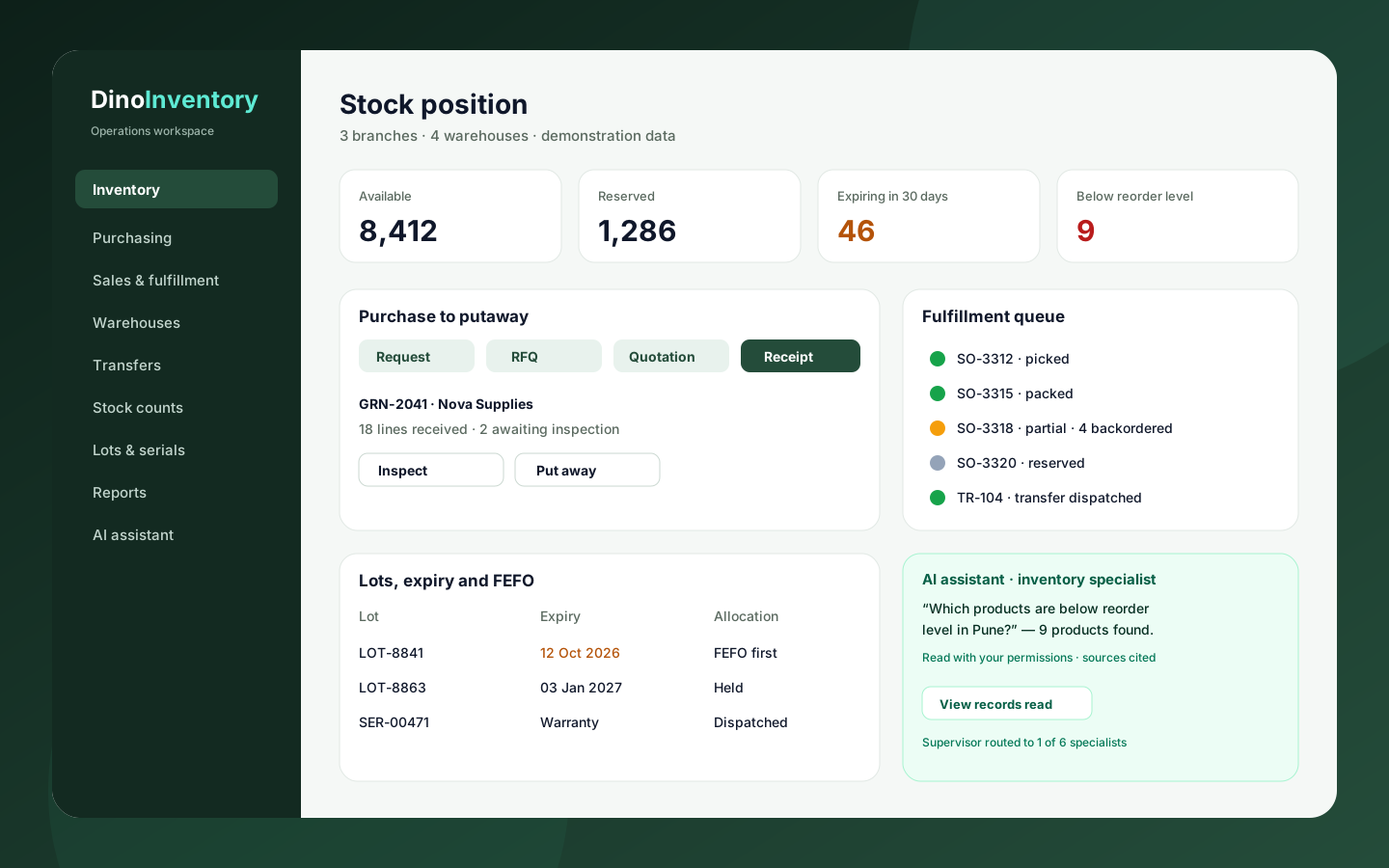
Dino Inventory operations workspace overview illustrating multi-warehouse balances, ledger traceability, and the six-specialist AI assistant
Dino Inventory vs Dino WMS vs Dino Business OS: Choosing the Right Layer
Buyers evaluating TechDino's supply chain catalogue often ask how Dino Inventory differs from Dino WMS and Dino Business OS. Each product targets a distinct operational boundary:
| System Capability | Dino Inventory (Branch Stock Control) | Dino WMS (Warehouse Floor Execution) | Dino Business OS / Dino ERP |
|---|---|---|---|
| Primary Operational Focus | Purchase-to-dispatch stock balances, backorders, transfers, and FEFO lot control across branches | Bin-level 3PL & warehouse execution: zones, aisles, racks, pallet putaway, and wave picking | Company-wide ERP: general ledger finance, HR, payroll, CRM, and manufacturing BOMs |
| Procurement Chain | Full requisition -> approval -> RFQ -> supplier quotation comparison -> PO -> QC receipt | Starts at inbound ASN / purchase order receiving dock | Integrated with accounts payable, vendor bills, and financial journal entries |
| Traceability & Allocation | FEFO lot allocation, expiry alerts, batch recalls, and unit-level serial/warranty history | Barcode/QR bin verification, LPN tracking, and cold-chain zone assignment | Batch valuation (FIFO / weighted average) tied to financial balance sheets |
| Stock Count Mechanism | Assigned counts against a frozen expected-quantity snapshot with variance approval | Cycle counting by aisle, zone, and bin location | Periodic inventory valuation adjustments |
Four Connected Inventory Chains: From Requisition to Traceability
Instead of treating purchasing, warehouse counts, and sales orders as isolated screens, Dino Inventory enforces strict state transitions across four connected workflows:
- 1. Purchasing, RFQs & Quality Inspection: Staff raise purchase requests with destination warehouse and business justification. Once approved, buyers issue RFQs, compare supplier quotations side by side, generate purchase orders, and record goods receipts with explicit quality inspection (separating accepted stock for putaway from failed quantities routed to purchase returns).
- 2. Sales Reservations, Partial Fulfillment & Backorders: Sales orders reserve available stock at the fulfilling branch. When only part of an order is on hand, warehouse staff pick, pack, and ship the ready quantity while the unfulfilled balance remains visible as an active backorder until replenishment arrives.
- 3. Inter-Warehouse Transfers & Frozen-Snapshot Stock Counts: Moving stock between branches requires transfer approval, dispatch logging, and destination receipt verification that records partial arrivals and transit discrepancies. When conducting physical audits, assigned stock counts freeze a snapshot of expected quantities so ongoing floor activity does not corrupt variance reviews.
- 4. FEFO Lot Allocation, Batch Recalls & Serial History: For pharmaceuticals, food, chemicals, and electronics, every lot carries an expiry date. First-Expired, First-Out (FEFO) allocation automatically prioritises earliest-expiring eligible stock while blocking expired or recalled batches, and serial numbers track unit location and warranty references.
How the Permission-Scoped Multi-Agent AI Assistant Works
Many enterprise teams hesitate to connect AI tools to live inventory databases because generic chatbots either hallucinate stock figures from stale exports or bypass branch-level access restrictions. Dino Inventory solves both problems through a transparent, permission-scoped multi-agent architecture:
- Supervisor + Six Domain Specialists: A supervisor agent analyses each plain-language question and routes it to the appropriate specialist—Inventory & Warehouse, Procurement, Sales & CRM, Finance, Manufacturing, or Policy—ensuring a ledger reconciliation question is never answered from a picking slip.
- Zero Elevated Privileges: Every specialist calls the exact same Node.js API endpoints as the web interface using the signed-in user's own session credentials, role, branch, and warehouse scope. If a warehouse clerk is restricted to the Hyderabad branch, the AI assistant cannot read or reveal Dubai stock balances.
- Visible Tool Calls & Qdrant Policy Grounding: Every AI response displays the underlying tool calls and live database records retrieved alongside the answer. Standard operating procedures (SOPs) and company policies are indexed in Qdrant vector search and cited by document title—or explicitly declared absent if no policy applies.
- Provider-Agnostic Model Slots with Automatic Fallbacks: Administrators connect their own API key (encrypted at rest, showing only the last four characters) and assign both a primary and a backup model for each capability: chat, embeddings, reranking, speech, and transcription.
Barcode Scanning, Offline Resilience, and Self-Hosted Deployment
Warehouse aisles and basement stockrooms often suffer from intermittent Wi-Fi. Dino Inventory includes a dedicated barcode scanning workspace to identify SKUs and lots rapidly, plus an offline change queue. When connectivity drops, supported stock operations queue locally in the browser and replay against the server upon reconnection—where every queued action is re-validated against current permissions and business rules rather than blindly overwriting records.
Whether your distribution network operates in India, the UAE and Gulf, Europe, or North America, deploying Dino Inventory on your own containerized VPS (with MySQL and Qdrant) keeps supplier pricing, stock margins, and customer records on infrastructure you control.
Review the full specification on the Dino Inventory product page, explore our AI agent development services and deployment and migration services, or contact TechDino to request a guided demonstration.
Frequently Asked Questions About Dino Inventory Software
Frequently Asked Questions
How does Dino Inventory prevent expired or recalled stock from being shipped?
Dino Inventory tracks lot numbers and expiration dates across every warehouse location. Its FEFO (First-Expired, First-Out) allocation rule automatically assigns the earliest-expiring eligible lot to sales orders while excluding expired batches and any lot flagged under an active batch recall.
Can the Dino Inventory AI assistant expose sensitive data to unauthorized staff?
No. The AI assistant executes every query through the same backend API and permission checks as the logged-in user's browser session. It maintains no separate shadow copy of operational records and strictly obeys the user's role, branch, and warehouse scope.
Why does Dino Inventory use a frozen snapshot for physical stock counts?
In busy warehouses, stock receipts and dispatches often continue while counters walk the aisles. Freezing an expected-quantity snapshot at the start of an assigned count gives supervisors a fixed baseline to evaluate physical variances before approving and posting ledger adjustments.
Which AI providers and models can we use with Dino Inventory?
Dino Inventory is provider-agnostic. You connect your own provider API key and configure a primary and backup model per capability—covering chat, embeddings, reranking, speech, and transcription—so a model timeout automatically falls over to your backup choice.
What is included in the Dino Inventory source code handover?
Buyers receive applicable source code for the agreed scope, including the Next.js operations workspace and public site, the Node.js API service, the MySQL schema and migrations, the supervisor and six specialist AI agent workflows, data store backup/restore scripts, and setup documentation.
Software in this article
Dino Inventory
AI-native inventory management software for products, purchasing, receiving, stock balances, sales fulfillment, warehouse transfers, stock counts, FEFO lot and serial traceability, reporting and a permission-scoped multi-agent AI assistant.
Dino WMS
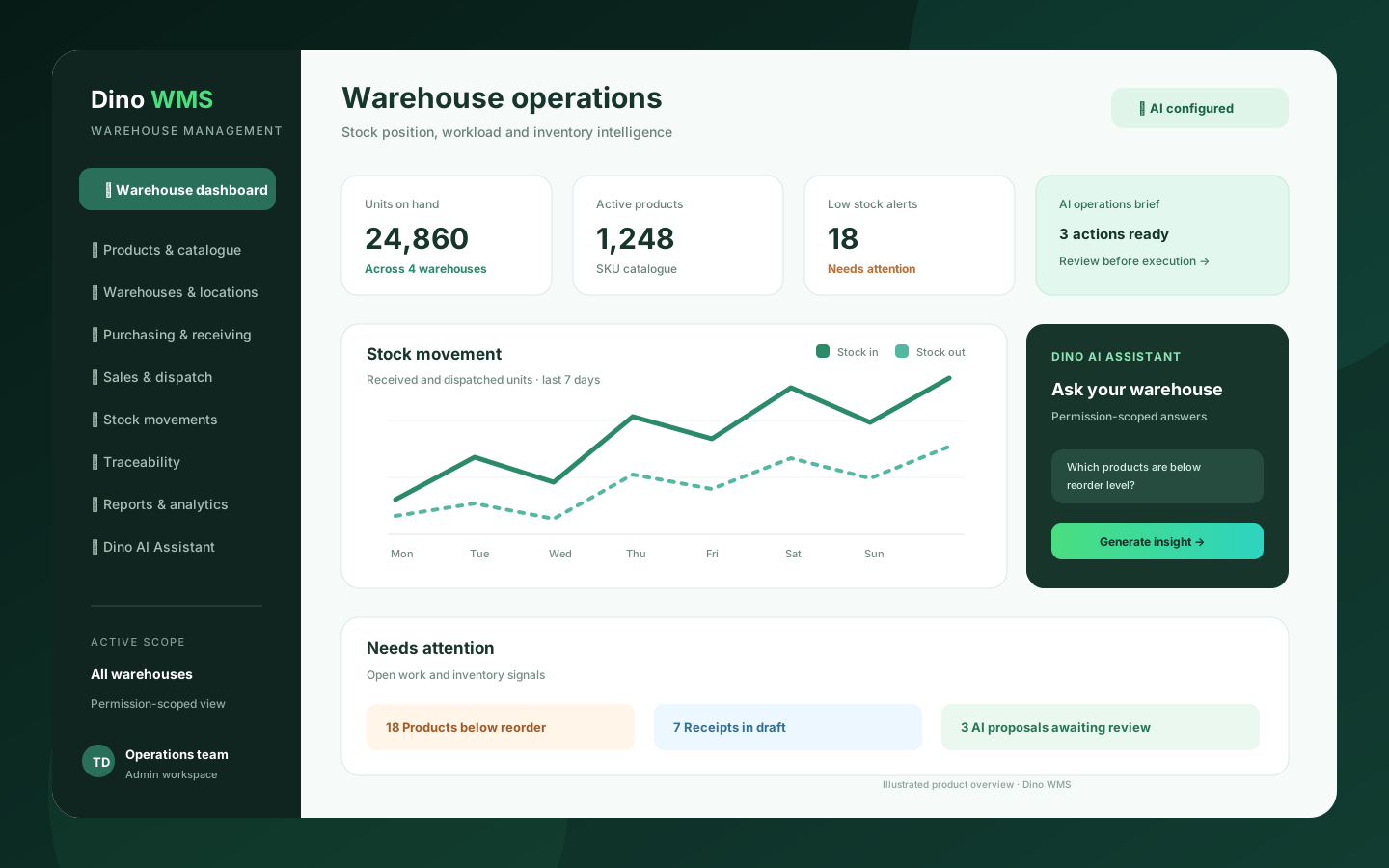
AI-powered warehouse management software for products, stock, warehouses, purchasing, receipts, picking, packing, dispatch, transfers, traceability and operational reporting.
Dino Business OS
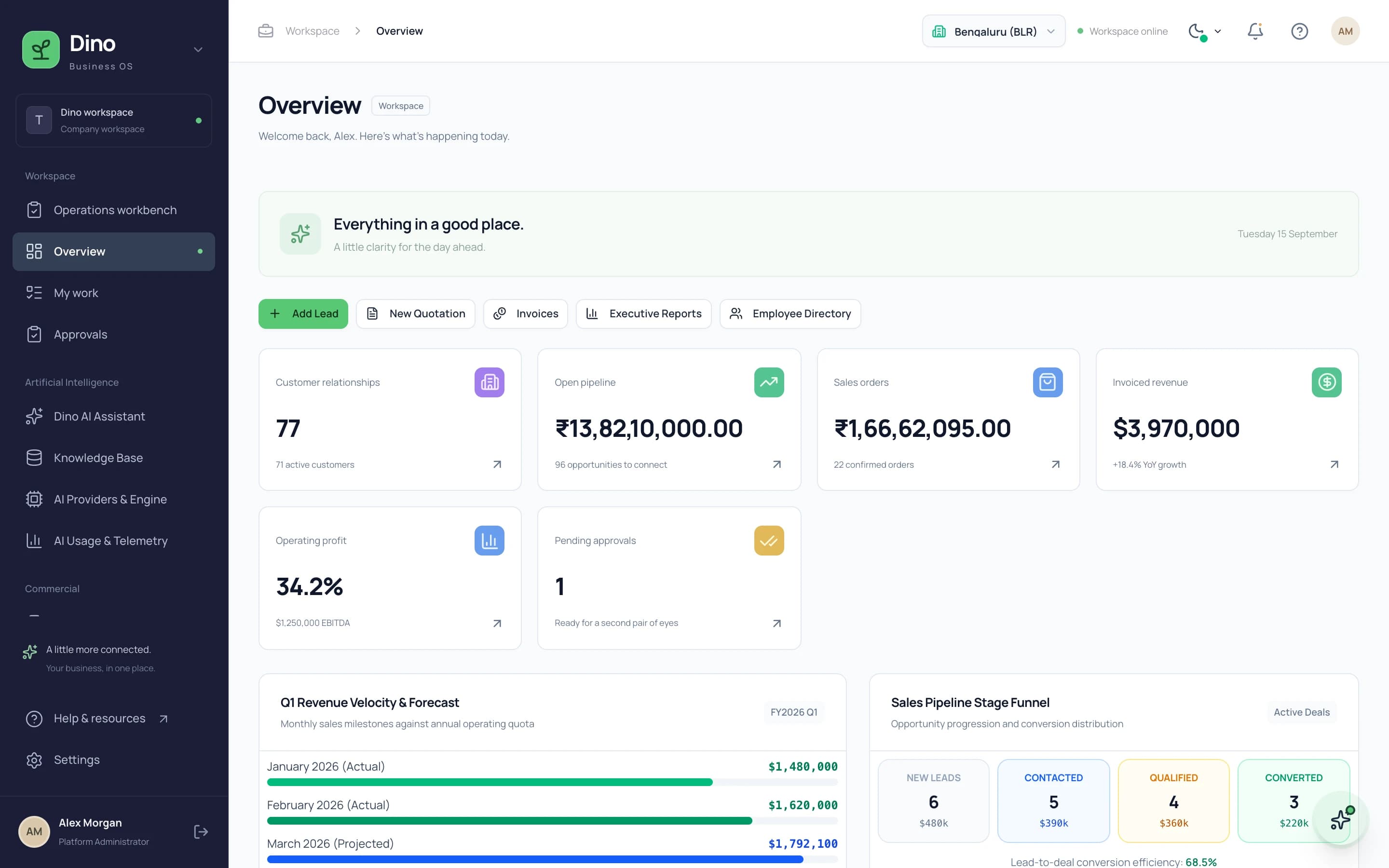
Dino Business OS is AI-powered business operations software that connects CRM, sales, procurement, inventory, projects, HR, payroll, service, assets, documents and finance in one permission-controlled workspace with a built-in LangGraph multi-agent AI assistant.
Explore Next
- Learn about our AI agent development services
Want Dino Inventory Under Your Brand?
Rebrand Dino Inventory with your logo and domain, or have it customized for your workflow. All quotes are customized and private.
Related Articles
Multi-Location Inventory Management Software: Real-Time Stock Sync & Batch Tracking
Discover how self-hosted multi-location inventory management software tracks stock balances, batch expiry dates, and automated purchase orders across warehouse networks.
Self-Hosted 360° Virtual Tour Software: WebGL Property Walkthroughs & Car Spins
Learn how Dino360 enables real estate agencies, property developers, and car dealerships to build and self-host interactive WebGL 360° property tours, floor-plan pins, and vehicle exterior photo spins without per-tour SaaS fees.