
The Unified Enterprise Core: Architecting Direct Bridges Between Sales CRM, ERP, and HRMS
Short answer
A unified enterprise architecture links CRM, ERP, and HRMS through transactional events and shared master data rather than manual CSV exports. When a sales rep closes a deal, the ERP automatically reserves inventory and triggers billing schedules, while the HRMS calculates rep commissions into the month-end payroll ledger, eliminating data silos across executive departments.
Software discussed: Dino ERP · Try the live demo
Most growing companies build their technology footprint incrementally: adopting one SaaS platform for customer relationship management, another legacy system for inventory and general ledger accounting, and a third cloud portal for human resources and payroll.
Over time, this fragmented approach produces fragile integration glue. Batch CSV exports, mismatched customer records, and broken webhook connections create operational delays that degrade customer experience and complicate executive decision-making.
The High Hidden Cost of Fragmented Enterprise Software Silos
When departments operate within disjointed platforms, every cross-functional transaction demands manual re-keying and spreadsheet reconciliation.
| Business Domain | Isolated System Symptom | Unified Architectural Solution | Operational Outcome |
|---|---|---|---|
| Sales to Fulfillment | Signed contracts sitting in CRM while warehouse remains uninformed | Direct event trigger: Deal Won auto-generates Sales Order in ERP | Immediate stock allocation and dispatch scheduling |
| Billing & Collections | Finance manually re-typing line items and customer billing addresses | Shared Customer Master Record across CRM and ERP general ledger | Elimination of invoice discrepancies and faster DSO |
| Commissions & Payroll | Finance and Sales arguing over spreadsheet commission calculations | HRMS commission engine calculating bonuses directly from settled ERP invoices | Transparent, automated incentive disbursement on pay day |
| Customer Service | Support agents unable to see customer payment status or order history | Single Customer 360 profile visible across CRM, ERP, and Helpdesk | First-contact resolution without cross-departmental ping-pong |
Event-Driven Data Flow: From Deal Closed-Won to General Ledger and Payroll
A modern enterprise core relies on asynchronous event-driven messaging (via Redis Pub/Sub, Kafka, or transactional database events) rather than point-to-point HTTP integrations.
- Event Emission: When an account executive marks an opportunity Closed-Won in the Sales CRM, the system publishes a verified deal.closed event containing agreed bill-of-materials and payment milestones.
- ERP Ingestion & Inventory Hold: The ERP consumer service picks up the event, creates a draft Sales Order, checks stock across regional warehouses, and places a hard allocation hold on required inventory.
- Billing Milestone Automation: The ERP finance module generates proforma tax invoices and dispatches payment links to the customer's finance contact based on agreed delivery milestones.
- HRMS Commission Accrual: Once the customer's settlement reflects in the ERP general ledger, an invoice.paid event notifies the HRMS payroll service to accrue sales incentives for the assigned representative's monthly compensation run.
Master Data Management (MDM) and Identity Federation
The foundation of a unified enterprise platform is a single source of truth for master entities. Customers, vendors, products, and employees must share canonical identifiers across all operational modules.
By integrating a centralized Identity Provider (supporting OIDC or SAML 2.0), employee role permissions propagate automatically: when an engineer is promoted or transferred inside the HRMS, their access rights across ERP manufacturing queues and CRM pipeline records update simultaneously.
Self-Hosted Deployment and Full Data Sovereignty
Deploying integrated enterprise platforms on self-hosted cloud instances gives businesses complete custody of customer records, financial books, and employee documents. Operating without per-seat SaaS licensing fees ensures technology budgets remain predictable as organizational headcount grows.
Frequently Asked Questions
Frequently Asked Questions
Can Dino ERP, Dino Sales CRM, and Dino HRMS share a single database?
Yes. The TechDino suite can be deployed either in a unified schema architecture with shared core tables or as modular micro-services communicating via transactional event queues.
How does sales commission tracking work between the CRM and HRMS?
Commission rules configured in Dino HRMS track payment clearance in Dino ERP, automatically accruing incentives and calculating applicable tax deductions during monthly payroll.
Does a unified suite require multiple login accounts for employees?
No. The system supports single sign-on (SSO), allowing employees to access CRM pipelines, ERP inventory, and HR attendance using one set of verified credentials.
Is complete source code provided for all three platforms?
Yes. TechDino licenses Dino ERP, Dino Sales CRM, and Dino HRMS with complete source code for the agreed scope, allowing organizations to self-host and customize workflows.
Software in this article
Dino ERP
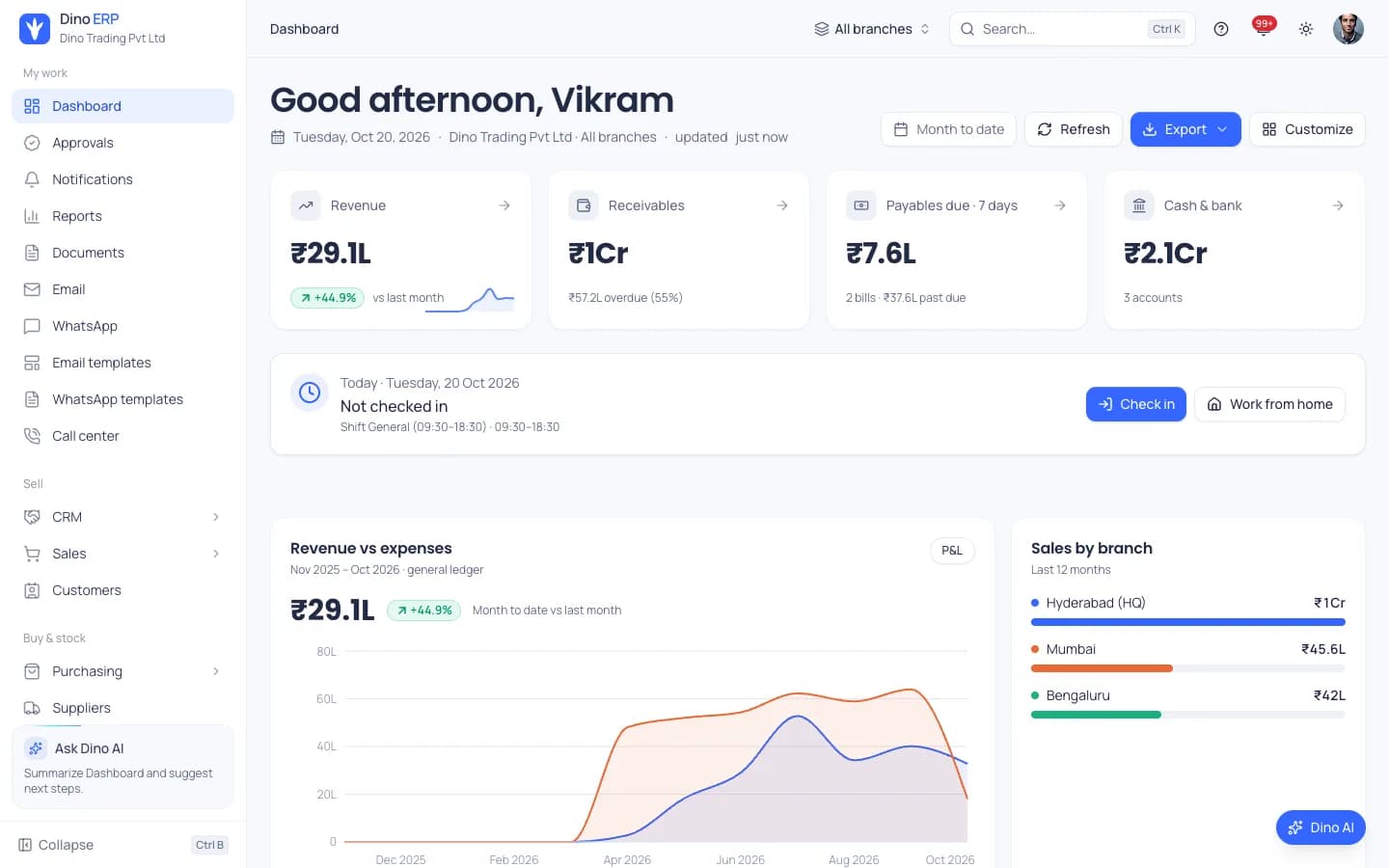
Dino ERP is an AI-powered, self-hosted, white-label ERP with 27 product areas across seven suites, including CRM, sales, purchasing, inventory and WMS, finance, country tax setup, HR and payroll, projects, manufacturing, quality, assets, helpdesk, POS, e-commerce, subscriptions, rental and portals, plus Dino AI for questions, document capture and forecasts.
Dino Sales CRM
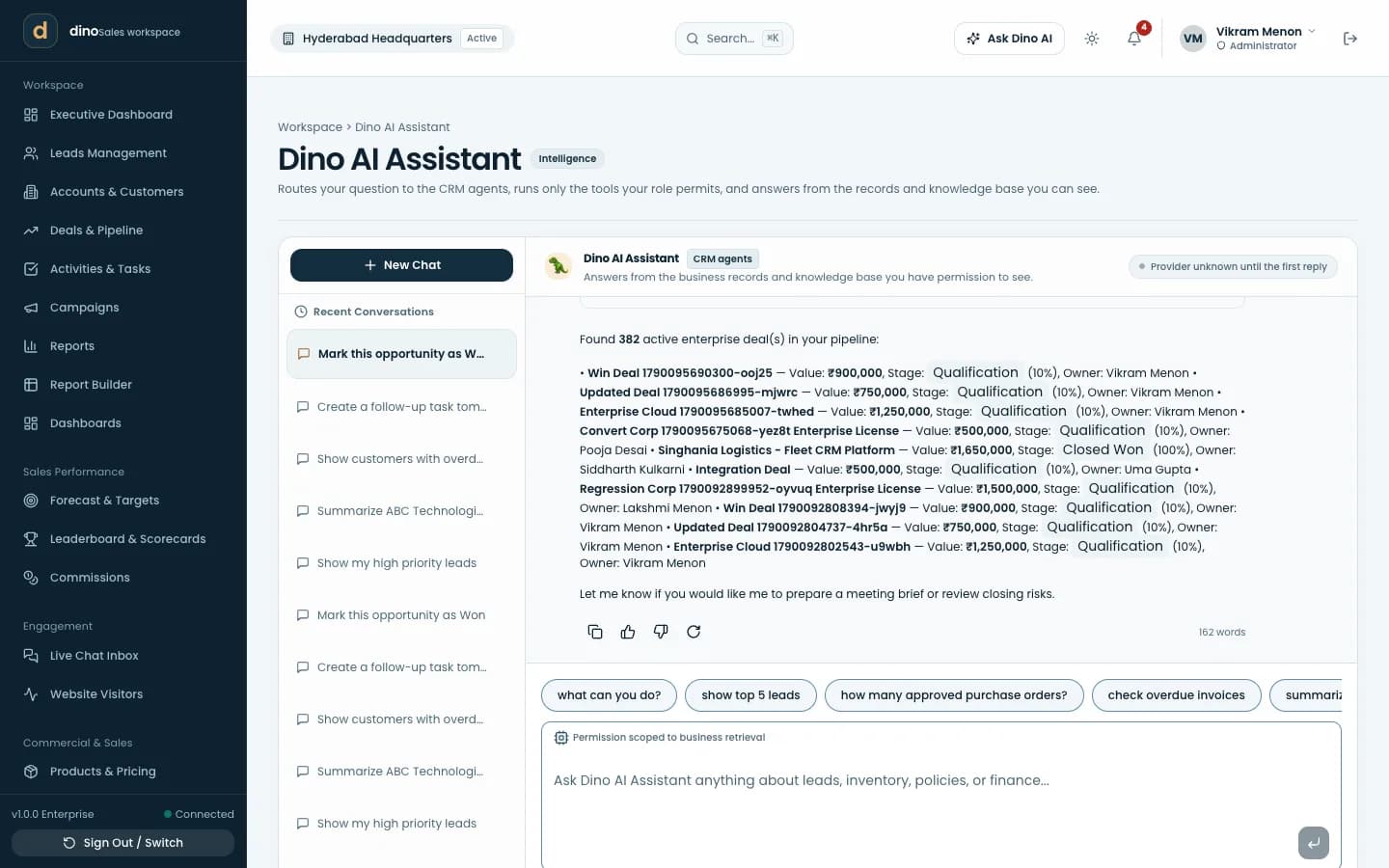
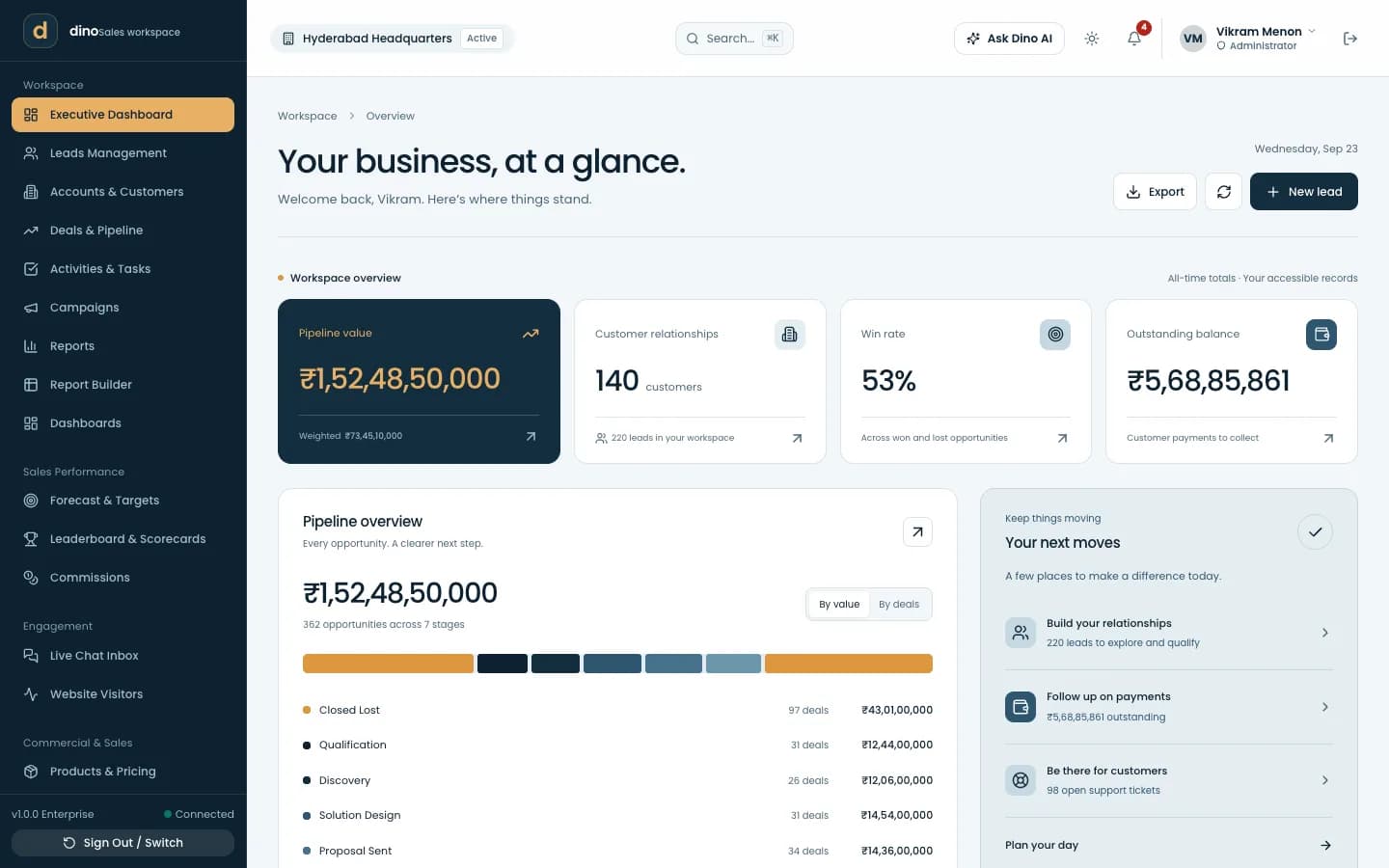
Dino Sales CRM is an AI-powered, white-label sales CRM with lead scoring, a configurable deal pipeline, quotations and approvals, invoices and aging, forecasting, commissions, support tickets and a Dino AI assistant grounded in your own records.
Dino HRMS
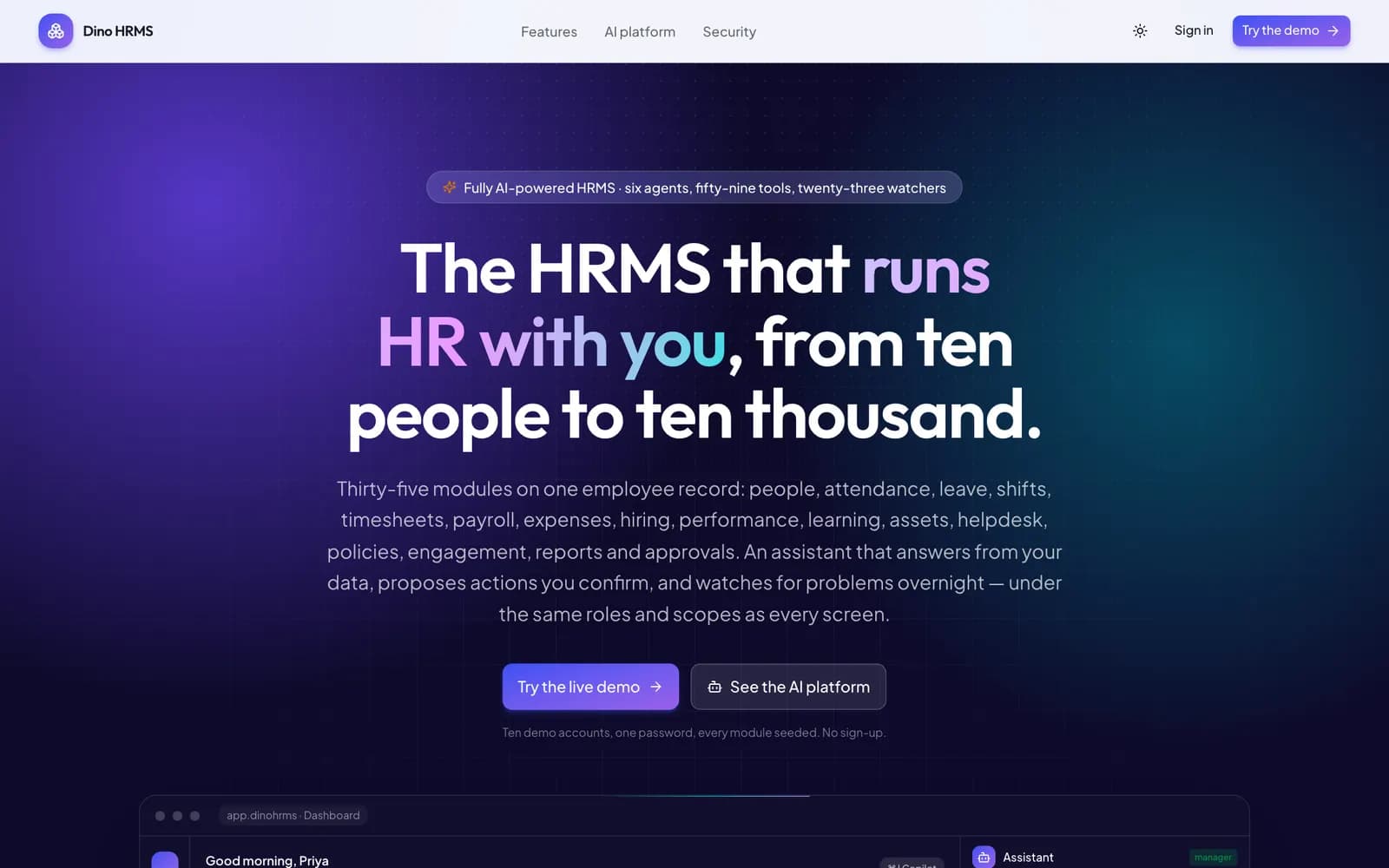
AI-powered white-label HRMS and payroll platform with 35 modules on one employee record — people, attendance, leave, shifts, timesheets, payroll, expenses, recruitment, performance, learning, assets, helpdesk, policies, engagement, workflows, reports and audit — plus six assistant agents and twenty-three automated watchers.
Want Dino ERP Under Your Brand?
Rebrand Dino ERP with your logo and domain, or have it customized for your workflow. All quotes are customized and private.
Related Articles
ERP Software with Source Code: What You Receive, What the Licence Allows and What It Costs to Run
Buying ERP once with the source code instead of renting it per user: what the handover contains, what the licence permits, a five-year cost framework and when it is the wrong choice.
AI Opportunity Scoring and Win-Loss Pattern Mining in Enterprise Sales CRM
How AI-powered B2B CRM engines analyze stakeholder engagement, quotation discount depth, and historical outcomes to prioritize high-probability pipeline deals.