
White-Label OTT Platform: How to Launch Your Own Streaming Service on Web, Mobile and Smart TV
Short answer
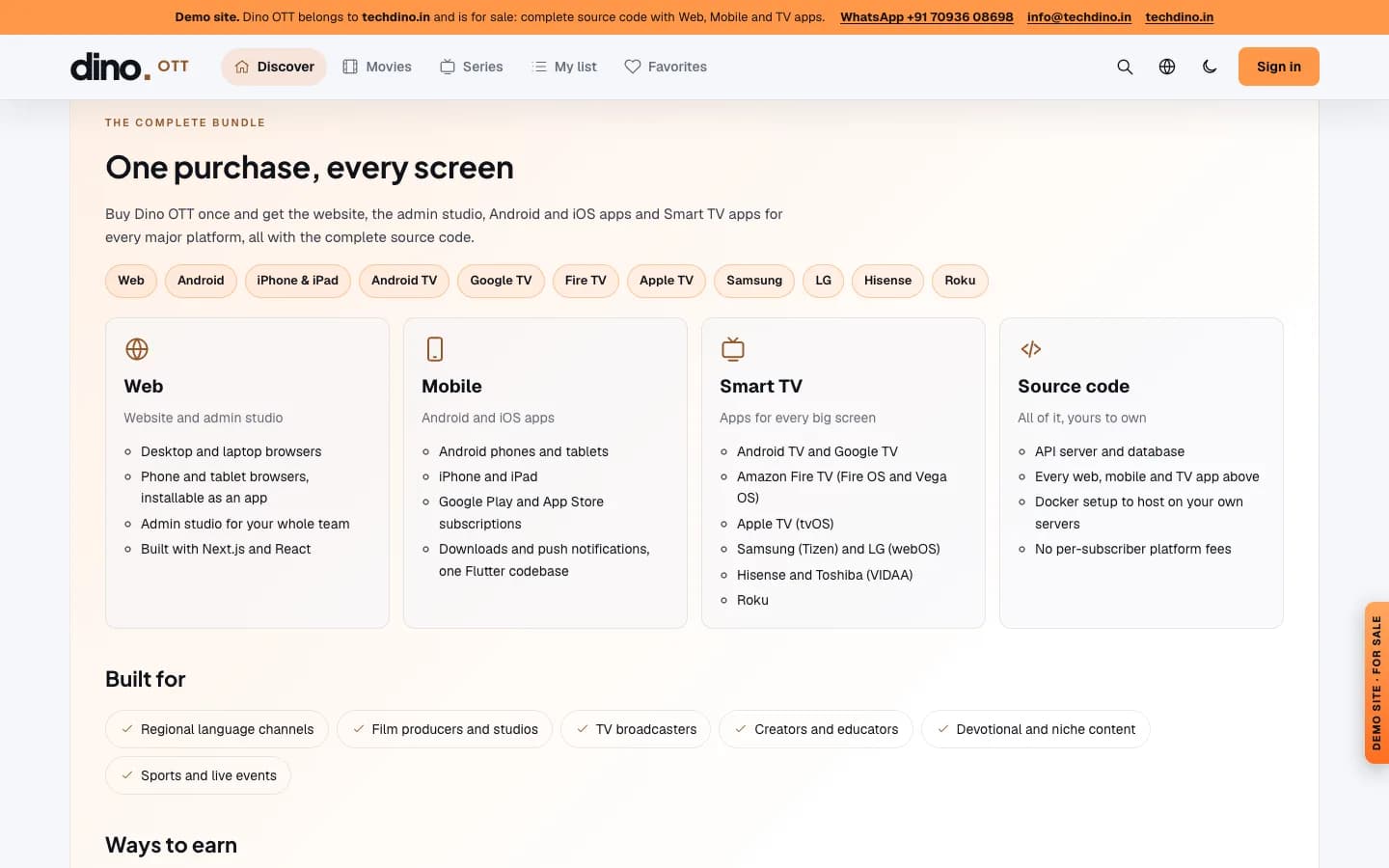
A white-label OTT platform is ready-made streaming software that a media business rebrands and runs as its own service. It bundles a customer website, Android and iOS apps, Smart TV apps, an admin studio for the catalogue, video packaging, payments and analytics. The buyer adds content, plans and payment accounts, then launches under its own name instead of building every app from scratch.
Software discussed: Dino OTT
OTT (over-the-top) streaming means delivering video straight to viewers over the internet, without a cable or satellite operator in between. Regional channels, film producers, broadcasters, coaches and devotional publishers all reach the same conclusion: their audience already watches on phones and Smart TVs, and a YouTube channel does not give them subscriptions, pricing control or the viewer relationship. Building a streaming service of their own looks like the answer, until the scope becomes clear.
What Is a White-Label OTT Platform?
A white-label OTT platform is a finished streaming product, built once and licensed to many operators, that each operator publishes under its own brand. Viewers see your name, logo and colours on the website, in the app stores and on the TV home screen. The software vendor stays invisible. With source-code delivery, the operator also controls hosting and can extend the product with its own developers.
The alternative paths are a custom build, which means designing and coding every app yourself, or a hosted OTT service, where you rent the platform monthly and the vendor runs the infrastructure. The comparison further down covers when each one fits.
What a Complete OTT Platform Includes
A streaming service is not one app. It is a set of applications and back-office systems that must agree with each other about who paid, what they may watch and on how many screens.
| Layer | What it does | In Dino OTT |
|---|---|---|
| Admin studio | Catalogue of movies, series, seasons and episodes, artwork, people and genres | 14 staff roles with a draft, review and publish workflow and an audit log |
| Video pipeline | Turns an uploaded master file into adaptive streams for every device | HLS and DASH packaging, renditions, DRM support and signed stream URLs |
| Customer website | Browse, search, subscribe and watch in a browser | Next.js and React, installable on phones and tablets |
| Mobile apps | Android and iOS apps with offline downloads and push | One Flutter codebase with Google Play and App Store subscriptions |
| Smart TV apps | Lean-back viewing on the living-room screen | Android TV, Google TV, Fire TV, Apple TV, Samsung, LG, VIDAA and Roku, paired by an on-screen code |
| Monetization | Plans, rentals, tickets, ads and coupons | SVOD, TVOD, pay-per-view, VAST ads, free trials and gift codes |
| Viewer accounts | Profiles, parental controls and device limits | Profiles, kids mode, parental PIN, device and simultaneous-stream limits per plan |
| Analytics | What is watched, by whom and how often | Views, likes, comments, per-title statistics and business dashboards |
Build, Rent or White-Label?
| Question | Custom build | Hosted OTT service | White-label with source code |
|---|---|---|---|
| Time to launch | Many months across web, mobile and several TV platforms | Fast; the vendor's apps are ready | Approximately two weeks of setup after scope, assets and access are confirmed, plus app-store review time |
| Upfront cost | Highest: a team for every platform | Low | A one-time purchase for the agreed scope |
| Recurring platform fees | None to a vendor; your own team costs | Monthly plans, and some vendors add per-subscriber or bandwidth charges | No per-subscriber platform fee; you pay your own hosting and providers |
| Brand control | Full | Limited to the vendor's templates | Full, including app-store and TV-store listings under your accounts |
| Source code | Yours | Not provided | Provided for the agreed scope |
| Who runs the servers | You | The vendor | You, on hosting you choose |
A hosted service suits a creator testing demand with a small catalogue. A custom build suits a large media group with unusual requirements and a permanent engineering budget. White-label with source code sits between them: a complete product on day one, under your brand, without a per-subscriber fee that grows as you succeed.
Which Devices Matter
Phones carry most viewing in markets such as India, Southeast Asia and Africa, while Smart TVs and streaming sticks dominate evening viewing in North America, Europe and the Gulf. Launching on every screen your audience uses is part of the product, not an afterthought.
| Platform | Typical devices | Store you publish to |
|---|---|---|
| Android TV and Google TV | Sony, TCL and Xiaomi TVs, Chromecast with Google TV | Google Play |
| Fire OS and Vega OS | Amazon Fire TV Stick and Fire TV sets | Amazon Appstore |
| tvOS | Apple TV | Apple App Store |
| Tizen | Samsung Smart TVs | Samsung Seller Office |
| webOS | LG Smart TVs | LG Seller Lounge |
| VIDAA | Hisense and Toshiba TVs | VIDAA app store |
| Roku OS | Roku players and Roku TVs | Roku Channel Store |
Each store has its own review process, content rules and developer account. Viewers on a TV rarely type a password with a remote, so Dino OTT pairs a TV by showing a short code that the viewer enters on the website or phone.
The Video Pipeline: Packaging, DRM and Delivery
- Upload: the studio accepts a high-quality master file for each title, trailer and episode.
- Packaging: the file is encoded into several bitrates and packaged as HLS and DASH, so the player can switch quality as the viewer's connection changes.
- Protection: DRM support and signed, expiring stream URLs stop a copied link from playing elsewhere. A DRM licence service is a separate provider account.
- Delivery: a CDN caches segments near viewers. CDN bandwidth is usually the largest running cost of a streaming service.
- Playback: each app's player requests the right stream, applies the plan's device and stream limits and reports viewing statistics back to the studio.
Costs You Still Pay After Buying the Platform
Owning the software removes the platform fee, not the cost of streaming. Budget for these before launch:
- Bandwidth: a 1080p stream at about 5 Mbps uses roughly 2.25 GB per viewing hour, so 10,000 hours of viewing moves about 22.5 TB through the CDN.
- Storage: masters plus every packaged rendition of each title.
- Servers: the API, database and admin studio, sized to your catalogue and concurrent viewers.
- DRM licences, if your content owners require studio-grade protection.
- Developer accounts: Apple charges an annual fee for its developer programme and Google Play a one-time registration fee; TV stores have their own requirements.
- Payment fees: gateway charges on web payments and app-store commissions on in-app subscriptions.
Content Rights and Compliance
The software is the easy part to license. Every title needs distribution rights for the territories, languages, devices and time window you plan to stream it in, and trailers and artwork carry their own permissions. Privacy law applies to viewer accounts and analytics: GDPR in Europe, CCPA and children's privacy rules such as COPPA in the US, and the DPDP Act in India. Age ratings, kids profiles and parental PINs help you apply local classification rules, but compliance stays with the operator, so review it with a lawyer in each launch market. India-specific rules are covered in how to start an OTT platform in India.
Launch Checklist
- Content: titles, trailers, artwork and signed rights for each launch territory.
- Brand: service name, logo, colours, domain and store listings.
- Plans: subscription tiers, rentals, live-event tickets, ad-free options and trial rules. The OTT monetization guide compares the models.
- Payments: gateway merchant accounts, plus Google Play and App Store developer accounts for in-app billing.
- Infrastructure: servers, storage, CDN and, if required, a DRM licence service.
- Legal: terms of use, privacy policy, age ratings and a grievance or takedown contact.
- Stores: Android, iOS and each TV store reviewed and approved before the launch date you announce.
For licensing details, read how source-code licensing works and what white-label software is. Market-specific notes are on the Dino OTT product page, and country pages such as Dino OTT in India cover currency and payment services.
Frequently Asked Questions
What is a white-label OTT platform?
It is ready-made streaming software that a media business publishes under its own brand. It includes the viewer apps, an admin studio, video packaging and payments, so the operator adds content and plans instead of building each app.
How long does it take to launch a white-label OTT service?
Setup of a standard branded deployment is estimated at approximately two weeks after scope, brand assets, hosting access and provider accounts are confirmed. App-store and TV-store reviews run on each store's own timeline, so plan the public launch date after approvals.
Does a white-label OTT platform include the movies?
No. The platform is software. The operator supplies the content and must hold distribution rights for each territory, language and device it streams to.
Which devices should an OTT service support first?
Start where your audience watches. Phone-first markets need Android and the mobile web, while North America, Europe and the Gulf expect Smart TV and streaming-stick apps such as Fire TV, Roku, Samsung, LG and Apple TV.
What are the biggest running costs of an OTT platform?
CDN bandwidth, video storage, servers, DRM licences where required, payment and app-store fees, and content licensing. Owning the source code removes per-subscriber platform fees but not these.
Can I see a Dino OTT demo?
Yes. Send an enquiry on WhatsApp or by email and demo access is shared directly. The demo is not linked publicly because its sample catalogue shows third-party trailers and artwork used only to demonstrate the platform.
The software in this article
Dino OTT
Dino OTT is a white-label OTT streaming platform with a customer website, an admin studio with 14 staff roles, Android and iOS apps from one Flutter codebase, and Smart TV apps for Android TV, Google TV, Fire TV, Apple TV, Samsung, LG, VIDAA and Roku, sold with the source code.
Want Dino OTT Under Your Brand?
Rebrand Dino OTT with your logo and domain, or have it customized for your workflow. All quotes are customized and private.
Related Articles
How to Start an OTT Platform in India: Regional Language Streaming, Payments and the IT Rules
A step-by-step plan for launching a regional language OTT service in India: content rights, the IT Rules 2021 and DPDP Act, UPI and app-store payments, devices and running costs.
OTT Monetization Models Explained: SVOD vs TVOD vs AVOD vs Pay-Per-View
How subscriptions, rentals, ads and pay-per-view work on a streaming service, which content suits each model, what app stores take, and the metrics that tell you it is working.