
Self-Hosted ERP vs SaaS ERP: Which Model Suits Your Business?
Short answer
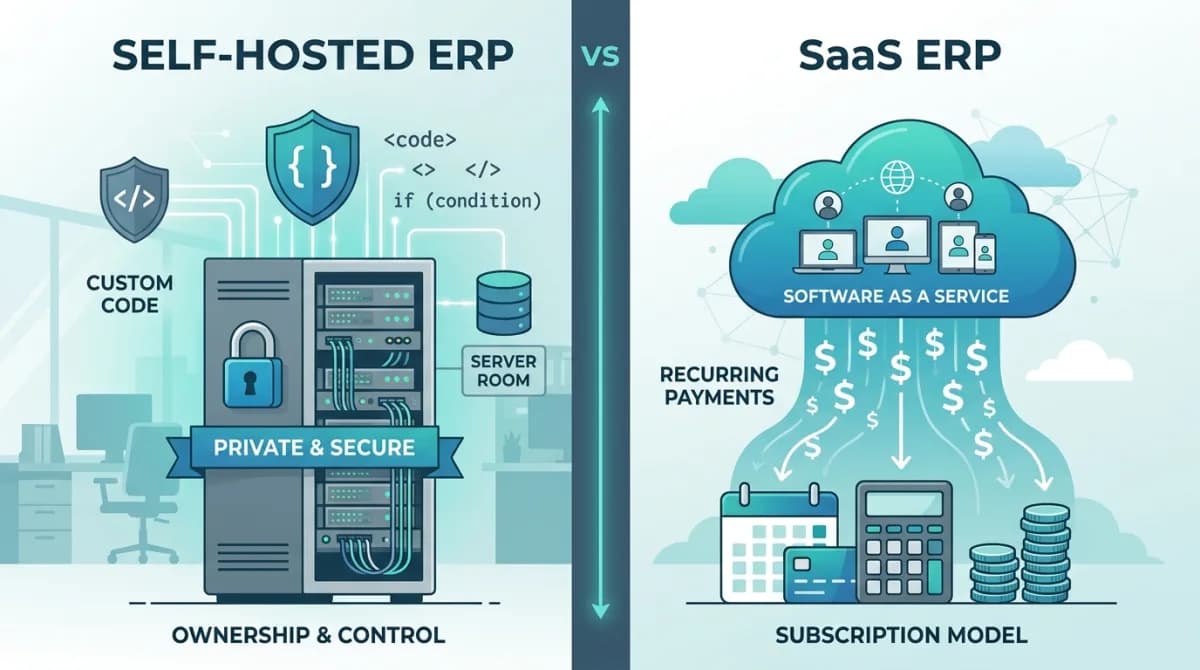
Self-hosted ERP is business operations software deployed on the buyer's own server with full source-code access and no mandatory recurring platform fees. SaaS ERP is hosted by the vendor on their cloud with monthly or annual subscriptions. Self-hosted suits businesses that need data control and long-term cost predictability; SaaS suits teams prioritising zero-maintenance hosting.
Software discussed: Dino ERP · Try the live demo
The Two ERP Delivery Models
Every enterprise technology leader faces a fundamental architectural choice when modernizing operational infrastructure: deploy self-hosted business software onto a private virtual server you control, or subscribe to a vendor-managed multi-tenant cloud application. While both approaches can provide core customer management, inventory tracking, and accounting capabilities, they diverge dramatically in long-term cost trajectory, data privacy compliance, and code customizability.
Both models deliver the same modules; what differs is who holds the keys. Under a subscription the vendor controls the deployment, the upgrade schedule and the data's physical location, and your configuration lives inside their product. With self-hosting you inherit those controls along with the responsibility for backups, patching and uptime, which is a genuine trade rather than a free win.
Side-by-Side Comparison Matrix
| Factor | Self-Hosted ERP on Private VPS | Multi-Tenant SaaS ERP Subscription |
|---|---|---|
| Upfront investment | One-time commercial license or codebase acquisition | Low initial cost, billed on recurring monthly cycle |
| Ongoing software fees | Zero mandatory recurring software fees; only standard VPS hosting (approx \$20 to \$60 per month) | Escalating per-user seat fees (\$40 to \$180 per employee per month) |
| 3-Year Total Cost of Ownership | Predictable, flat cost structure that decreases per user as company scales | Substantially higher total expenditure due to recurring user tier jumps |
| Source code access | Delivered complete for backend API, frontend web app, and database migrations | Proprietary black-box; client cannot inspect or modify underlying logic |
| Data residency and privacy | Stored locally on your chosen data center in India, UAE, or EU jurisdiction | Stored on shared multi-tenant cloud servers under vendor control |
| Custom workflow modification | Freedom to customize schemas, reports, and internal workflows | Constrained strictly to vendor feature roadmaps and generic UI toggles |
| Vendor lock-in exposure | Minimal; database and codebase belong to your engineering custody | Severe; export formats are proprietary and price hikes must be absorbed |
| AI provider integration | Connect your own private API keys and select models freely | Restricted to vendor-selected artificial intelligence features with markups |
Read the matrix over a three-year horizon rather than a monthly one. Subscription pricing looks smaller in month one and overtakes a one-time purchase somewhere between year one and year two for most teams above fifteen users, because seat costs scale with headcount while a self-hosted licence does not. The crossover point is the number worth calculating before either option is shortlisted.
When Self-Hosted ERP Makes Commercial Sense
- Your organization employs twenty or more team members across branches, making per-seat SaaS licensing economically disadvantageous
- Regional privacy laws or industry mandates require company data to reside on domestic private servers in Hyderabad, Mumbai, Dubai, or Frankfurt
- Your business operates proprietary pricing formulas, custom discount matrix rules, or unique supply-chain workflows
- You possess internal technical capability or work with a trusted systems partner to oversee a containerized Docker stack
- You require direct database access for custom business intelligence dashboards, automated backups, and external reporting integrations
One practical test settles it for most teams: ask what happens if you stop paying. If the answer is that operations halt within thirty days, and your business runs processes you have refined over years, the dependency is worth pricing. If the answer is that you would happily switch tools next quarter anyway, a subscription is the cheaper and more honest choice.
When Multi-Tenant SaaS Remains Viable
For micro-enterprises with fewer than five employees who lack any technical expertise, multi-tenant cloud subscriptions offer immediate utility without server maintenance. However, once business transaction volume expands and custom departmental workflows emerge, the constraints of closed platforms become a major operational bottleneck.
There is also a sequencing argument. A young company with unsettled processes benefits from a subscription it can abandon cheaply, and self-hosting rewards businesses whose workflows have stabilised enough to be worth encoding. The mistake is treating the choice as permanent: teams routinely start on a subscription, learn what they actually need, and move to owned software once the requirement list stops changing every quarter.
Frequently Asked Questions
Frequently Asked Questions
Is self-hosted ERP more expensive upfront?
Yes, the initial purchase involves a one-time software license and deployment setup. However, over a two to three-year horizon, self-hosted software is substantially more cost-effective because per-seat subscription fees are completely eliminated.
Can I migrate from SaaS ERP to self-hosted later?
Yes, provided your current SaaS tool allows CSV or JSON database exports. Starting directly with self-hosted software avoids complex subsequent data extraction and migration hurdles.
Do self-hosted ERPs receive updates?
Yes. Software grants include foundational code releases, and TechDino includes three months of complimentary technical support to assist with deployment, configuration, and maintenance.
What hosting platforms can run self-hosted ERP?
Self-hosted platforms with Docker Compose can be installed on Hostinger VPS, DigitalOcean, AWS EC2, Google Cloud, Hetzner, or private on-premise hardware.
Software in this article
Dino ERP
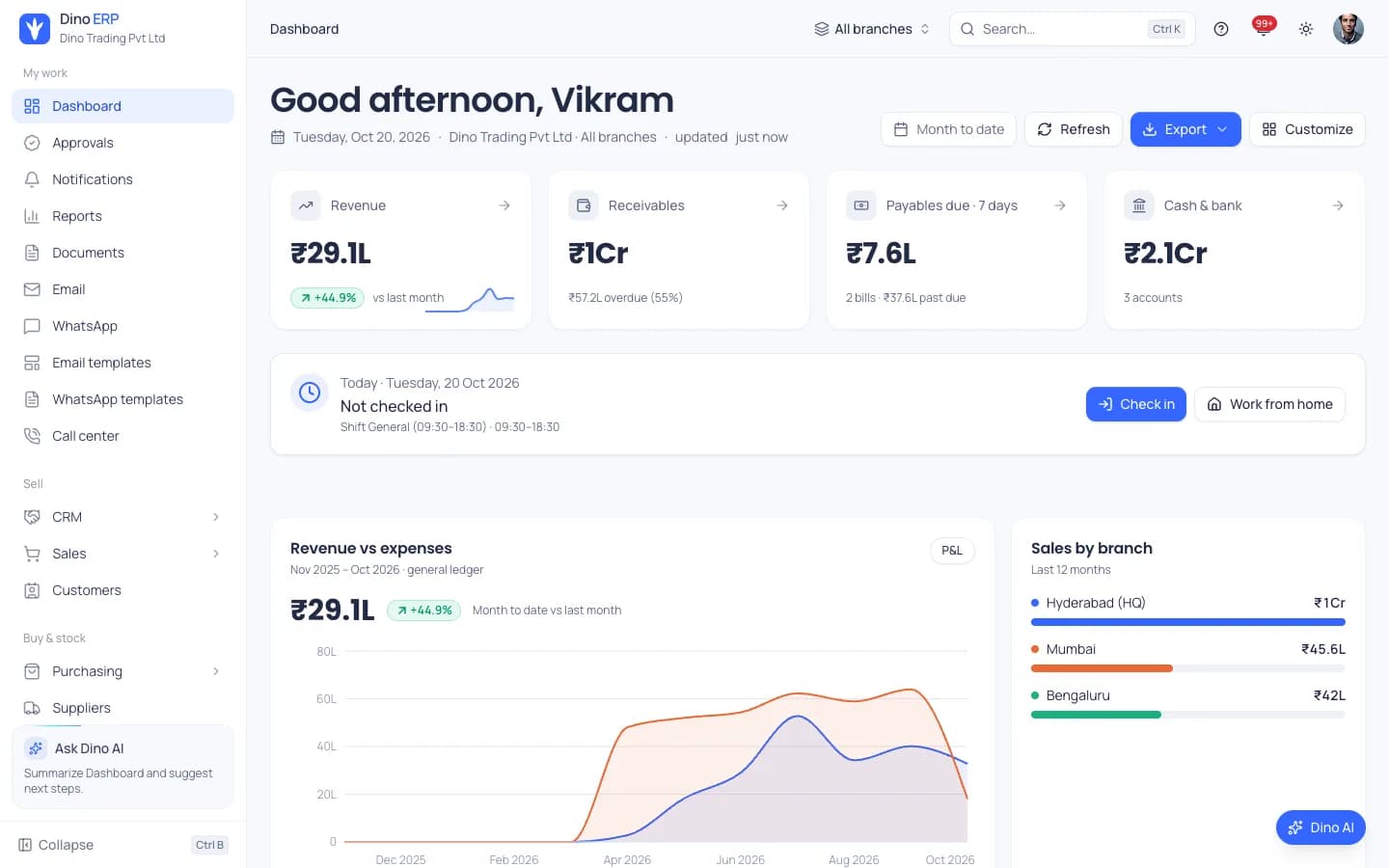
Dino ERP is an AI-powered, self-hosted, white-label ERP with 27 product areas across seven suites, including CRM, sales, purchasing, inventory and WMS, finance, country tax setup, HR and payroll, projects, manufacturing, quality, assets, helpdesk, POS, e-commerce, subscriptions, rental and portals, plus Dino AI for questions, document capture and forecasts.
Dino Business OS
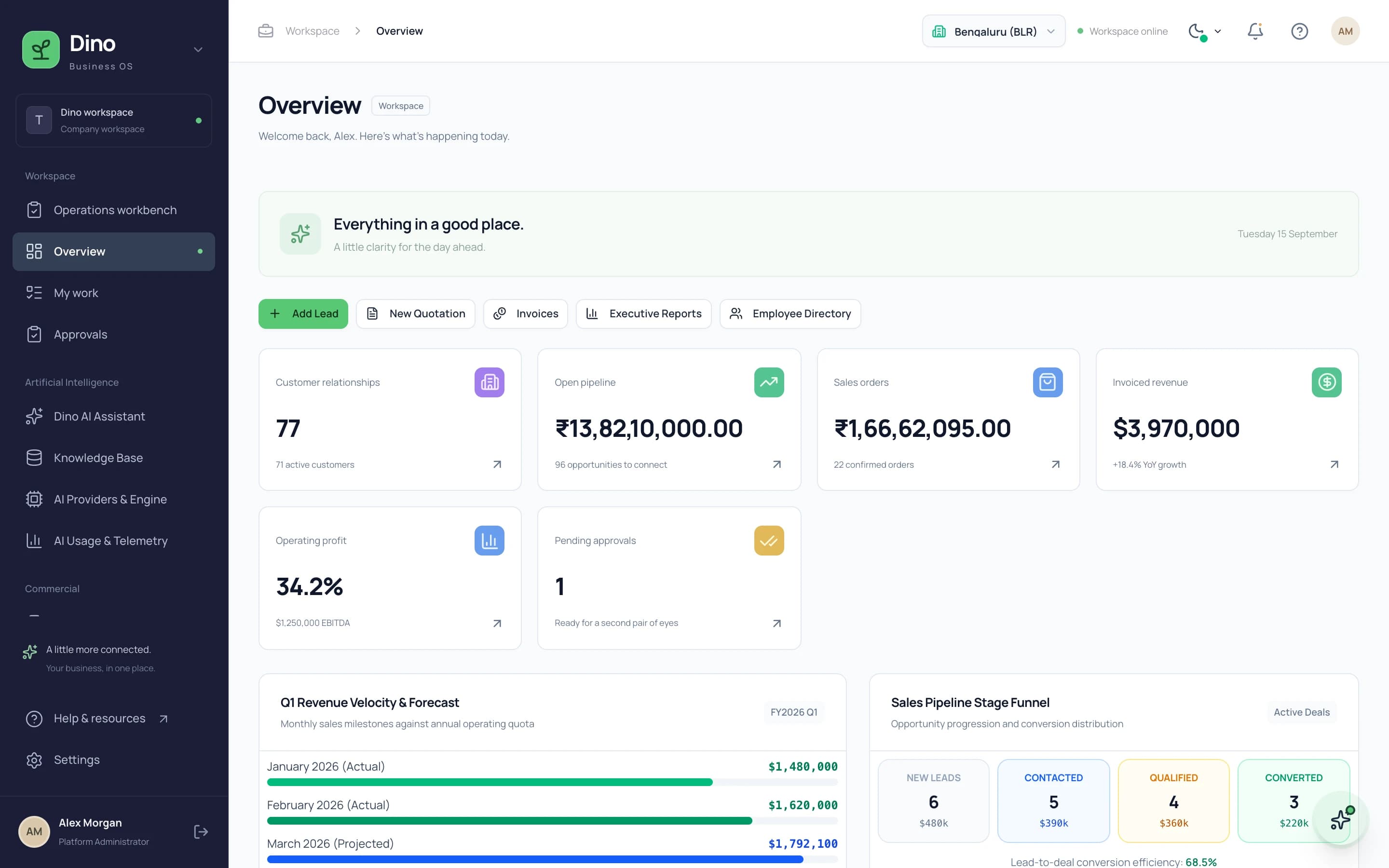
Dino Business OS is AI-powered business operations software that connects CRM, sales, procurement, inventory, projects, HR, payroll, service, assets, documents and finance in one permission-controlled workspace with a built-in LangGraph multi-agent AI assistant.
Dino HRMS
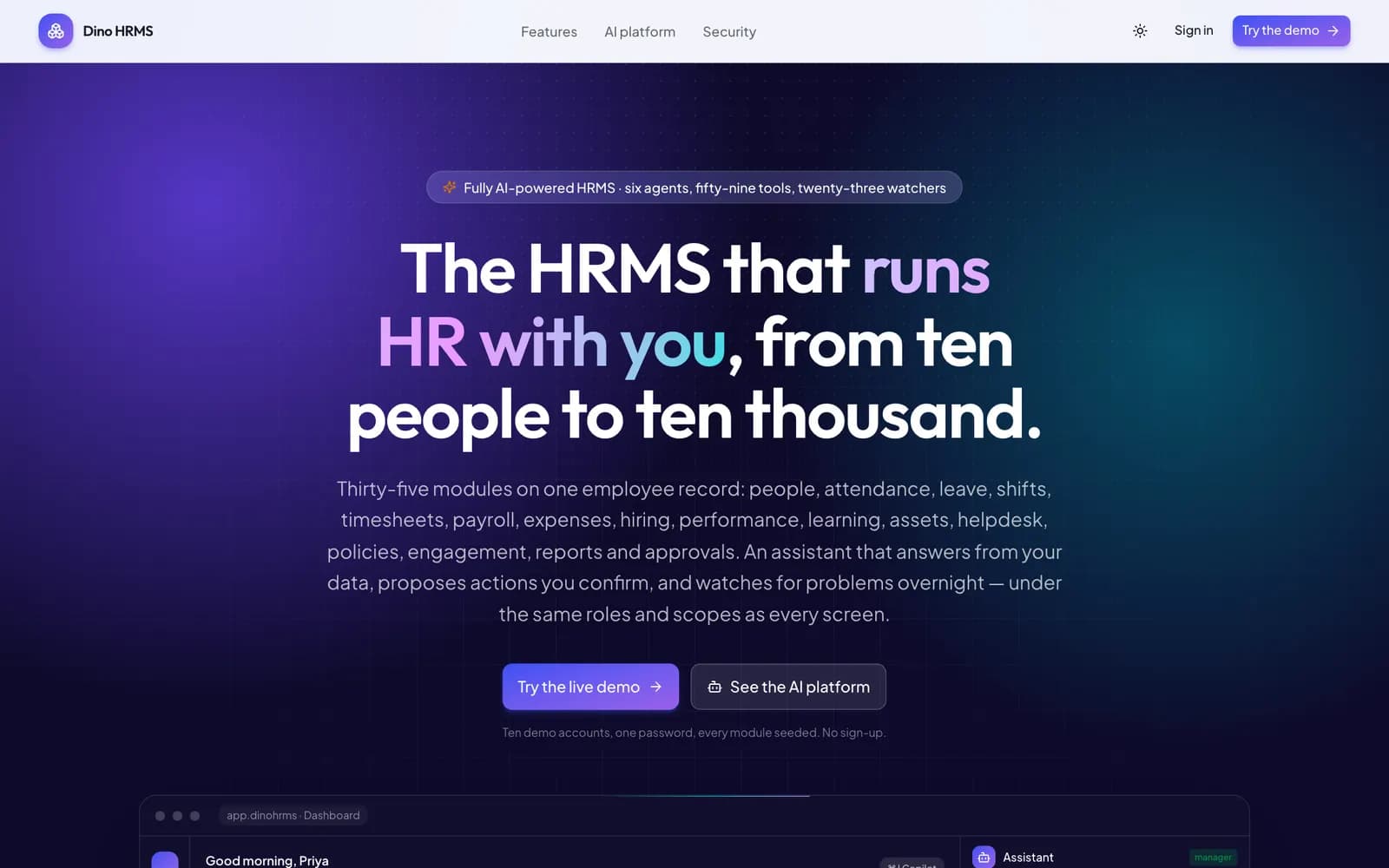
AI-powered white-label HRMS and payroll platform with 35 modules on one employee record — people, attendance, leave, shifts, timesheets, payroll, expenses, recruitment, performance, learning, assets, helpdesk, policies, engagement, workflows, reports and audit — plus six assistant agents and twenty-three automated watchers.
Want Dino ERP Under Your Brand?
Rebrand Dino ERP with your logo and domain, or have it customized for your workflow. All quotes are customized and private.
Related Articles
Procurement and Inventory Management Software: Feature Checklist
A comprehensive feature checklist for procurement and inventory management software covering purchase requests, supplier orders, goods receipts, branch stock, valuation and reporting.
Role-Based Access Control in Business Software: How RBAC Works
A practical guide to how role-based access control works in business ERP software, covering roles, permissions, module access, branch scoping and why AI assistants need permission-scoped queries.